
We’re virtually three months in and I’ve been thinking about 2026.
And if I’m honest… it’s not all “AI will save us” and people doing yoga on rooftops while passive income rolls in. It’s more… spreadsheet meets mild panic.
The uncomfortable truth
Most businesses, from what I can see, are running on two settings:
- Cut costs
- Don’t get into trouble
That’s it.
Marketing? Risky.
Innovation? Even riskier.
R&D? Sounds expensive – let’s not get carried away.
So instead, we ‘optimise’. We trim. We remove.
We efficiently suffocate the bloody life out of things.
And now AI has entered the chat… holding a very large invoice.
The AI bill is coming (and guess how it’ll be sold)
Here’s the bit that makes me slightly twitchy.
Tech companies have spent insane amounts of money on AI. At some point, they need that money back.
And there’s one dead-easy way to sell anything in business:
“This will save you money.”
Not:
“This will delight your customers.”
“This will grow your brand.”
“This will create long-term value.”
No. Just:
“Fewer people. Lower cost. Done.”
Which brings me to something I can’t stop thinking about…
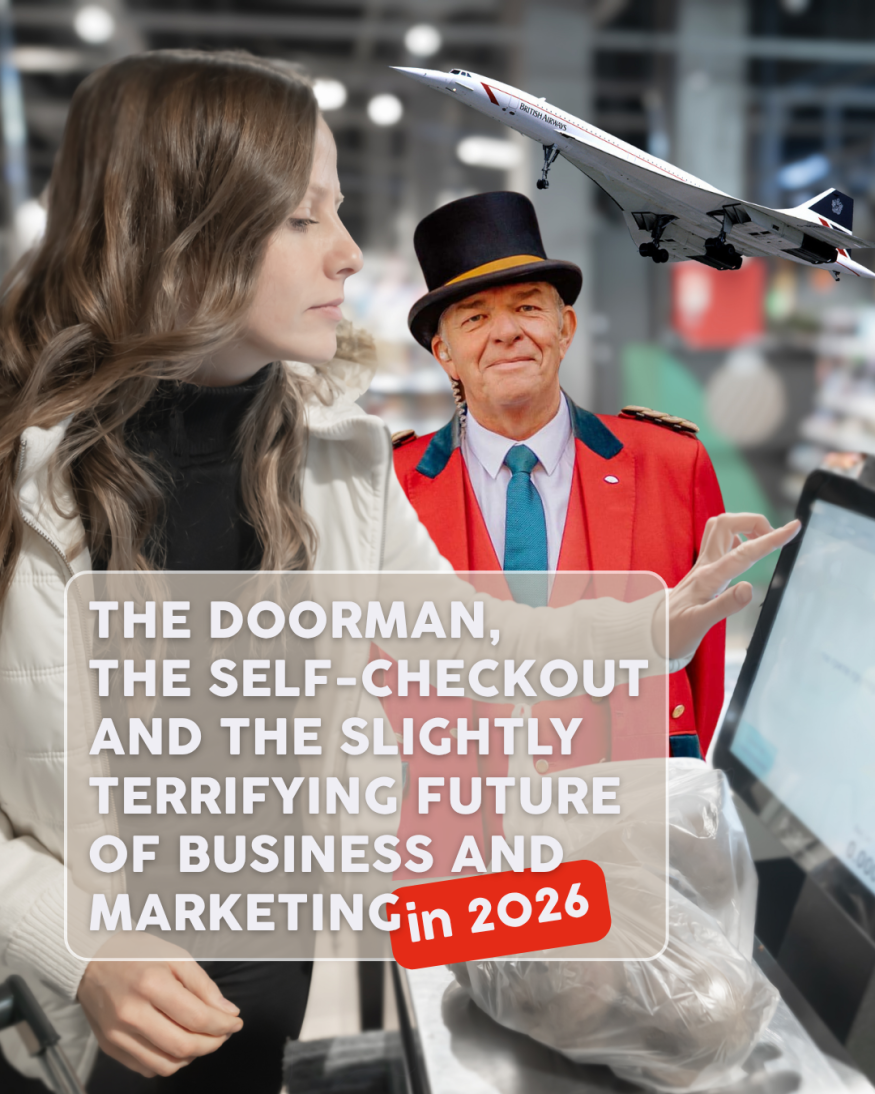
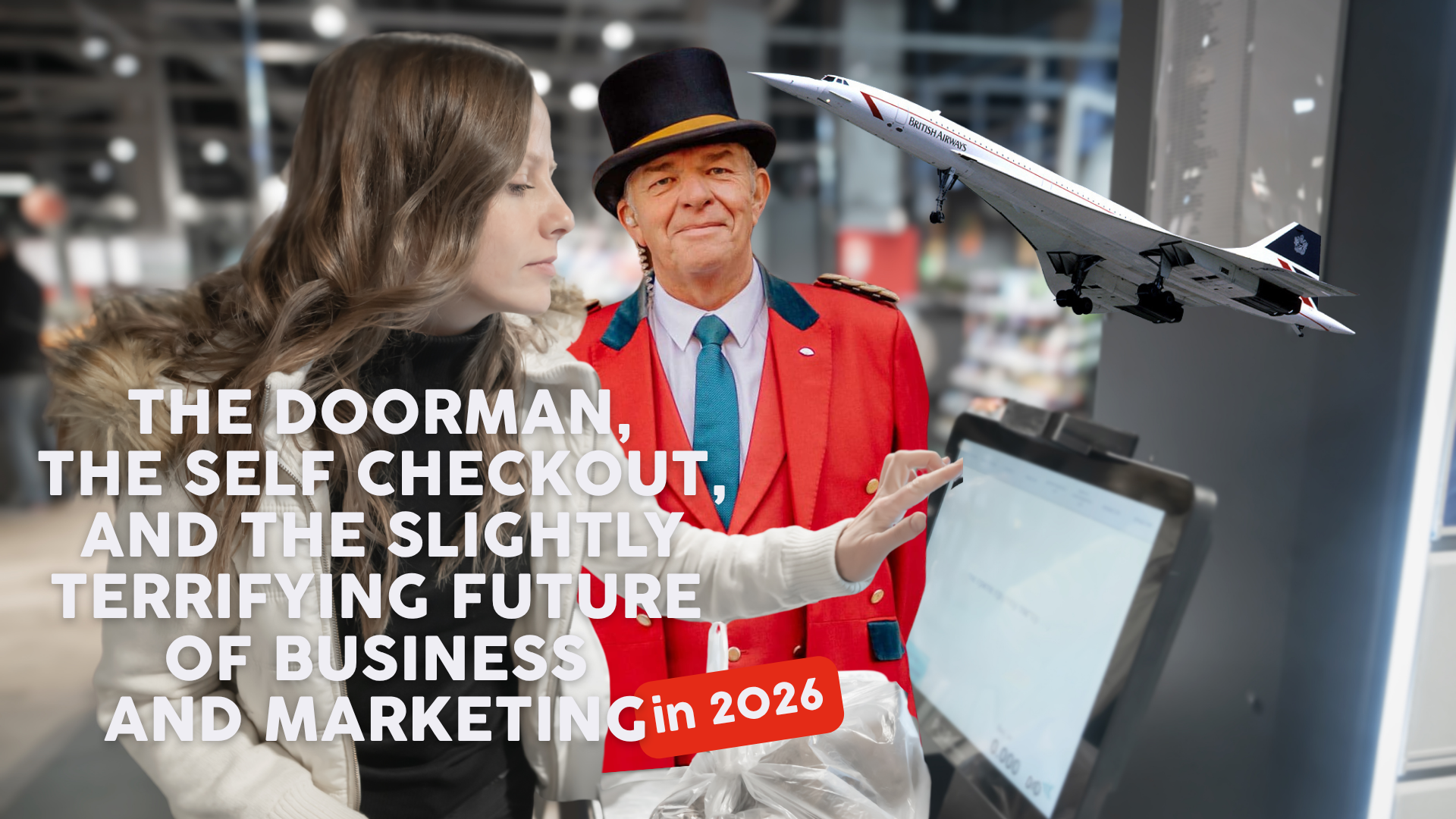
The Doorman Fallacy (or: how to accidentally ruin everything)
Imagine you run a hotel.
A consultant walks in and says, “How much do you pay your doorman?”
You tell them.
They nod wisely and say, “Ah. But the doorman opens the door. We can replace that with an automatic door.”
Money saved. Everyone claps. Consultant invoices. Job done.
Except…
The doorman didn’t just open the door.
He greeted guests.
He spotted trouble.
He hailed taxis.
He made people feel important.
Remove him, and yes – you save money.
But five years later:
Your best customers have gone.
The entrance looks like a bus stop at 3am.
Your brand quietly dies.
And no one ever goes back to the consultant and says, “Mate… about that idea.”
We’ve already done this (hello, self-checkouts)
Supermarkets did exactly this.
Self-checkout started as an option.
Quick shop? Few items? Lovely.
Then someone in finance noticed it was cheaper.
And suddenly it wasn’t an option anymore.
It was basically: “Congratulations, you now work here.”
And we all know what followed:
- People scanning avocados as onions
- Shoplifting going through the roof
- The weekly shop turning into an Olympic event
(Seriously – try doing a full trolley solo. You need three hands and the emotional stability of a bomb disposal expert.)
The real problem: we reward cost savings… not value destruction
This is the bit that should make every marketer sit up a bit straighter.
In most organisations:
- If you reduce costs → you get praised
- If you destroy value → someone else deals with it later
It’s like applauding someone for removing the engine from a car because it’s lighter… then acting surprised when it won’t move.
The Bit No One Likes to Admit
Sometimes…
It’s just timing.
Right crowd.
Right mood.
Right moment.
And your job?
Show up anyway.
Even when it’s dead.
Even when it’s awkward.
Even when you’re internally writing your resignation letter to a job no one actually hired you for.
Because every now and then…
Sunday turns up.
Where marketing quietly gets it right (and everyone else gets it wrong)
There are a few things marketers understand that the rest of business seems determined to forget:
1. Different beats better
You don’t always win by being cheaper or faster.
Sometimes you win by being distinct.
2. Humans matter more than systems
You can optimise everything…
But one good human interaction will outperform a perfect process.
There was research on Royal Mail that found something brilliant:
It didn’t matter how reliable the service was.
What mattered was whether you liked your postie.
That’s it.
You could have a flawless system – but if Dave the Postman is a bit of a misery, the brand suffers.
Meanwhile, slightly dodgy delivery + “Don’t worry, I left it round the back for you” = best service ever.
And yet… we’re removing the humans
Because you can’t easily measure:
- Trust
- Warmth
- Reassurance
- “He just sorted it for me”
But you can measure:
- Cost per interaction
- Time per call
- Headcount reduction
So guess which wins?
The madness of “lowest cost channel”
Every business is currently trying to push customers to the cheapest possible interaction.
“Use the website.”
“Don’t call.”
“Definitely don’t talk to a human.”
Meanwhile…
- Website conversion: ~0.5%
- Phone call conversion: ~30%
And we’re hiding the phone number.
It’s like owning a pub and boarding up the bar because glasses are expensive.
What happens next (my slightly worrying prediction)
I think we’re about to go through three phases:
Phase 1: Same, but cheaper
AI used to reduce cost and headcount.
More automation. Less human contact.
Phase 2: Same, but better
Smarter businesses realise:
“Hang on… what if we use this to improve the experience?”
(Spoiler: these are often founder-led or family businesses — the ones not obsessed with quarterly panic.)
Phase 3: Completely different
This is where it gets interesting.
We stop asking:
“How do we do what we’ve always done… faster?”
And start asking:
“What would we build if this technology existed from the start?”
A small but powerful shift (that most people miss)
If content becomes cheap and fast to produce…
Why are we still waiting for briefs?
Why not create first… then find the buyer?
Some creators already do this.
They make the thing.
Then sell it.
Agencies could do the same.
Less “What do you want?”
More “We made this. Do you want it?”
Even Cannes could shift from:
“Look what we did last year”
To:
“Here’s what we’ve built — who wants it?”
The bit that hit me hardest
Here’s the real takeaway.
Don’t sell what you do. Sell how you think.
Because what you do can always be questioned:
“Do we need this?”
“Can we cut this?”
“Is this too expensive?”
But how you think?
That’s the bit that stops businesses making catastrophically stupid decisions.
The Concorde problem (or: clever… but completely impractical)
Concorde was engineering genius.
Fly from London to New York – you arrive before you left. Brilliant!
But the return journey?
An absolute faff.
Early start. Whole day lost. Logistically annoying.
Engineers optimised for speed.
No one asked, “Is this actually a good experience for a human?”
And that’s the risk we’re walking into again
Optimising:
- Speed
- Cost
- Efficiency
While quietly ignoring:
- How it feels
- How it’s experienced
- Whether people actually want it
Final thought (the one worth nicking)
If there isn’t a marketer in the room… There’s a very real chance the business is about to make a perfectly rational… completely stupid decision.
Takeaway: In a world obsessed with efficiency, the advantage won’t go to the fastest or cheapest.
It’ll go to the ones who remember something wildly unfashionable:
People aren’t spreadsheets.
And if you forget that…
You might save money.
But you’ll slowly, quietly… lose everything else.