
There’s a strange thing about being a karaoke host..
Everybody knows what you cost, but not everybody understands what you’re worth.
And before anyone starts sharpening their pitchforks, this isn’t a rant about pub landlords, venue managers or the bloke who thinks he’s Freddie Mercury because he’s managed to grow a moustache. It’s an observation. MY observation. One I’ve arrived at after spending a fair amount of time behind a microphone, watching people, creating ideas, building a reputation and occasionally wondering whether the chap murdering Robbie Williams has actually heard the original song.
I think some entertainment venues fundamentally misunderstand what they’re buying when they book a karaoke host.
And, to be fair, I understand why.
The Karaoke Machine Isn’t the Entertainment
From a venue’s perspective, the equation looks straightforward.
Book karaoke. Advertise karaoke. People arrive. People drink. Till goes ker-ching.
Lovely.
Except it doesn’t quite work like that. If it did, every pub with a microphone and a laptop would be absolutely rammed on a Wednesday afternoon.
A karaoke machine is equipment. A microphone is equipment. A screen showing the words to Mustang Sally for the 14,000th time is equipment. None of those things creates an atmosphere. People create atmosphere.
And the person responsible for bringing those people together has a rather important job. A good host reads the room. They know when to encourage someone, when to leave them alone, when to change the music, when to make a joke and, perhaps most importantly, when to shut up. That last one has taken me about 30 years to master and some would argue the training is ongoing.
They (try to) remember names. They welcome newcomers. They make nervous singers feel like superstars and confident singers feel part of something bigger, and they keep the room entertained even when nobody wants to sing, because sometimes, people just want a pint, a laugh and somewhere they feel comfortable.
And there’s actually some research behind why that matters.
The Pub Is Worth More Than What’s in the Till
In 2017, researchers at the University of Oxford examined the relationship between regular pub attendance, social interaction and wellbeing. They found that people who had a regular local pub tended to be more socially engaged, more content and more trusting of their communities. Those without a regular local tended to have smaller social networks.
The research wasn’t about karaoke specifically, and it doesn’t establish that visiting a pub causes greater happiness. But it does reinforce something I’ve come to believe.
People don’t just return to places. They return to relationships.
Source: University of Oxford – Your health! The benefits of social drinking
And that’s where entertainment can become something more valuable than simply filling three hours on a Thursday evening..
I’ve seen how people who arrive as strangers can become friends. How somebody who initially refuses to sing eventually gets up. How regular customers make newcomers feel welcome. How a group of people with very little in common can suddenly unite over an absolutely catastrophic rendition of Living on a Prayer.
It’s wonderful. (Although Bon Jovi might disagree.)
That sense of belonging doesn’t necessarily show up immediately on a till report, but it can give customers a reason to return.
And surely that’s something any venue should want?!
We’ve Become Very Good at Advertising Things. Less Good at Giving People a Reason to Attend.
Now, this is where my marketing background starts getting restless.
I’ve spent more than 30 years working in marketing, communications and presenting, and one thing I’ve learned is that marketing isn’t about producing more ‘stuff’.
It’s about giving people a compelling reason to care.
Which brings me to the modern ‘pub entertainmen’t poster.
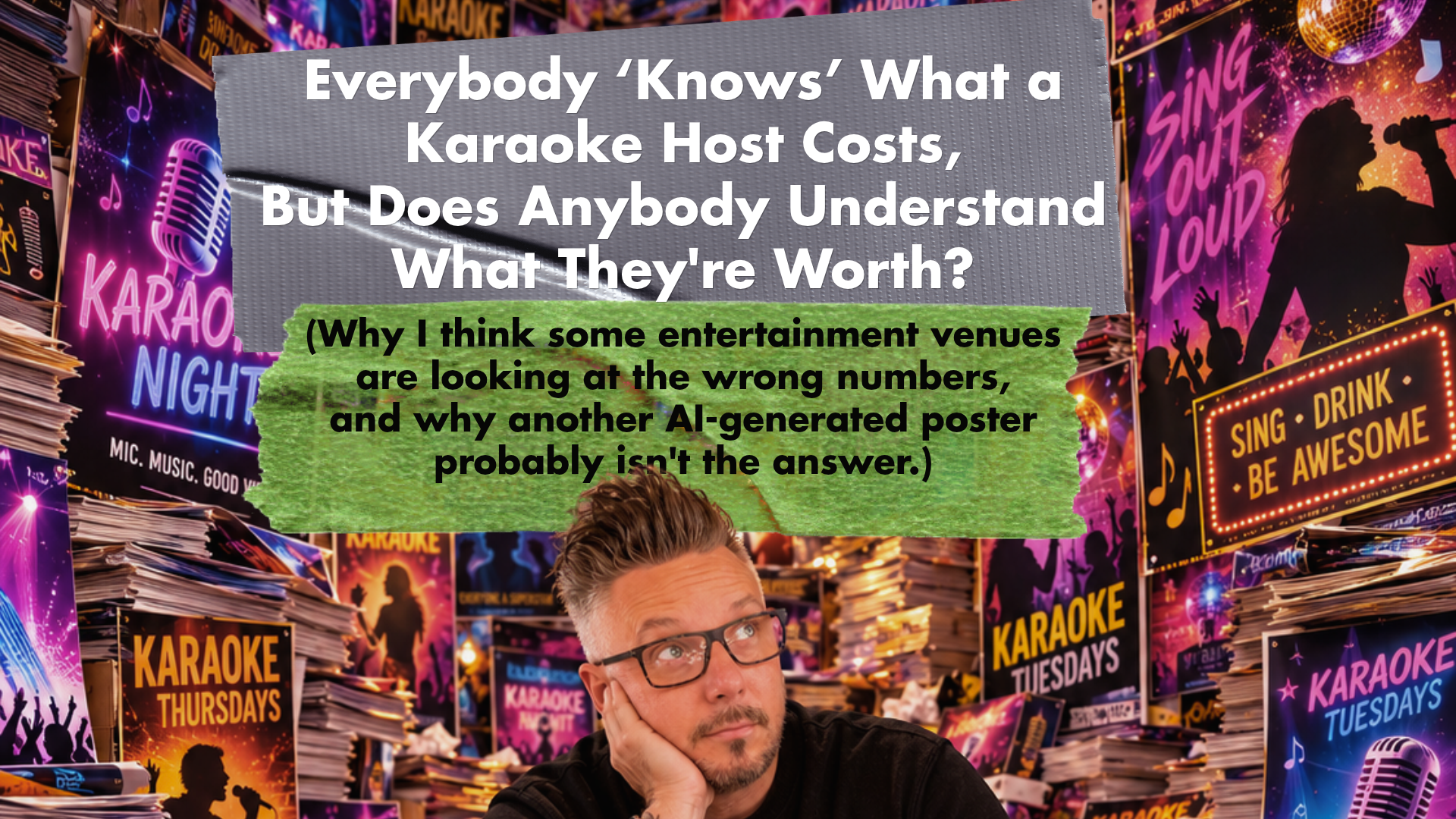
You know the one… Neon microphones. Exploding musical notes. A crowd of impossibly attractive people apparently experiencing the greatest night of their lives. Someone looking suspiciously like Beyoncé, despite the actual audience consisting of Dave, Barry, three regulars and a chap who’s fallen asleep next to the fruit machine. All brought to you by artificial intelligence and Chat GPT.
Now, before anyone accuses me of being anti-technology, I’m not. I use AI. It’s useful. It can save time, generate ideas and help smaller businesses produce things they couldn’t otherwise afford.
But it cannot replace understanding your customers. And interestingly, consumers appear to be noticing the difference.
Case Study One: When More Content Starts Meaning Less
In May 2025, digital experience company Optimizely published research involving 100 UK marketers and 1,000 UK consumers.
It found, that 57% of consumers considered AI-generated seasonal marketing content impersonal and repetitive.
At the same time, 78% of marketers planned to increase their use of AI-generated seasonal content.
Think about that…
Marketers want to produce more of something that a substantial proportion of consumers already find repetitive.
Source: Optimizely – Optimize Everything research, May 2025
Now, that research wasn’t specifically about karaoke posters, but I suspect anyone who’s spent five minutes scrolling through Facebook events will recognise the problem.
Different pub. Different night. Same microphone. Same neon lights. Same AI-generated crowd looking like they’ve just won the lottery. And remarkably similar wording promising an unforgettable night.
It’s what’s known as ‘marketing wallpape’r.
And when everything looks ‘spectacular’, nothing looks particularly ‘special’.
I’m not arguing that venues should stop using AI, I’m arguing that AI should help communicate an idea, not become the idea. Because nobody gets off the sofa on a rainy Wednesday afternoon because someone has generated a particularly impressive picture of a microphone, they come because you’ve given them a reason.
People Are Already Drowning in Advertising
There’s another piece of research that should make venue managers think.
In July 2024, Capterra surveyed 499 regular UK online shoppers.
A remarkable 91% agreed that they saw too many adverts on social media.
More than a third reported blocking specific advertising, while 35% had unfollowed a brand in the previous 12 months.
Source: Capterra – Social Media Ad Fatigue, July 2024
Again, the research wasn’t exclusively about pub entertainment or organic social posts, but it certainly highlights a wider challenge.
People are overwhelmed with promotional content, so why do we think posting another generic karaoke graphic, with the same handful of hashtags, is suddenly going to persuade someone to abandon their comfortable sofa?
Sometimes we need fewer posters and better ideas. Show people the atmosphere, tell the stories, introduce the regulars, with their permission. Show what makes your venue different, give your event a personality people recognise.
Because people connect with people.
Not Photoshop’s increasingly overenthusiastic AI cousin.
Why I Don’t Call My Shows ‘Marc Ford Karaoke’
One thing I’ve deliberately tried to do is avoid making every event about me.
Yes, I’ve got a name. Yes, I’ve got a website. And yes, I’ve spent years in marketing, radio, presenting and entertainment.
But I don’t particularly want to be the star; I’m not the world’s greatest karaoke host; I’m not a semi-retired professional singer; I don’t possess a huge following of devoted fans who travel across the Midlands to witness my magnificent handling of a microphone, (although if anybody wants to start such a movement, I won’t stop you).
I’ve tried to develop actual shows instead.
Take ‘TFI Karaoke’.
It’s not just karaoke on a Wednesday afternoon.
It’s become a little ‘midweek party’. Reportedly something people can look forward to in their week. A reason to get out of the house, meet friends, have a laugh and sing something that probably should have stayed in 1987. An event with its own identity, humour, audience and atmosphere.
And that identity is deliberately bigger than me.
Because the customers are the stars. I’m just the idiot trying to hold it all together.
That’s my particular approach to marketing. Create something people genuinely want to be part of, then give them something to talk about.
When You Start Feeling Undervalued
Here’s where I’ll get a little personal.
I’ve worked hard to develop a reputation, and not as the ‘greatest entertainer’ in the country as some will have you believe.
There are hosts with better equipment, better singing voices, bigger audiences and considerably more impressive lighting rigs.
Some probably have all four. (Show-offs).
But I do believe I’ve developed something worthwhile. I’ve created ideas, themes, identities, promotional material and a recognisable way of presenting events. I’ve put time into understanding audiences and trying to build something people actually want to attend.
And yes, there have been occasions when I’ve felt undervalued…
Not simply in terms of money, (although my electricity supplier remains stubbornly uninterested in being paid through audience applause).
It’s more about how the contribution is understood, because, when all that work gets reduced to “someone doing karaoke”, it can feel as though the thinking behind it has become invisible.
But here’s an important distinction.
Feeling undervalued doesn’t necessarily mean someone is deliberately undervaluing you.
Sometimes they simply don’t see the work, and sometimes we entertainers haven’t explained that work particularly well. That’s something I have to take responsibility for too.
Venues Look at the Till. Hosts Look at the Room.
A venue manager has perfectly legitimate concerns.
Wages. Stock. Rent. Business rates. Energy bills.
The ongoing mystery of why commercial dishwashers appear to be manufactured from the same materials as space rockets, judging by the repair costs.
They need people through the door.
They need sales.
And they need entertainment that contributes commercially.
I completely understand that.
But the host may be looking at something else.
The woman who comes every week because it’s her main opportunity to socialise.
The couple who first met at karaoke.
The nervous newcomer who’s finally found somewhere they feel comfortable.
The regular who brings a friend, who brings another friend, who eventually becomes part of the community.
The venue sees the afternoon’s takings.
The host sees the relationships developing.
Both matter.
And I think the most successful venues are the ones that understand how those two perspectives work together.
Of course, there’s no point having a wonderful atmosphere if the business is losing money indefinitely.
But there’s also a danger in judging every entertainment event entirely on the takings from one afternoon or evening.
Loyalty takes time.
Habits take time.
Communities take time.
And if you keep changing the entertainment before any of those things have a chance to develop, perhaps you’re measuring the wrong thing.
A Karaoke Host Isn’t a Miracle Worker
I should also point out that hosts aren’t exempt from responsibility.
We cannot simply arrive, switch on a microphone, tell three jokes and expect eternal gratitude.
We need to understand the venue.
Who are its existing customers?
Who would it like to attract?
What kind of experience fits the business?
What can we realistically achieve?
And how do we know whether it’s working?
Because if a venue has poor service, an unwelcoming atmosphere or a reputation that makes new customers uncomfortable, even the finest karaoke host in Britain won’t fix everything.
Not even with a particularly uplifting rendition of Sweet Caroline.
A host can contribute to a successful venue.
They cannot single-handedly solve every problem in the hospitality industry.
But equally, venues need to recognise that a good host brings more than a songbook.
They bring judgement, personality, consistency, creativity and, in some cases, marketing expertise.
That’s a rather different proposition from hiring someone simply to operate the equipment.
Maybe We’re Asking the Wrong Question
Rather than asking:
“How much does a karaoke host cost?”
Perhaps venues should also be asking:
“What sort of experience are we trying to create?”
“Who are we trying to attract?”
“Why would somebody choose us over the pub down the road?”
“What will make them return?”
“And how can our entertainment help make that happen?”
Because the cheapest host isn’t necessarily the best value.
And the most expensive host isn’t automatically the best either.
The real measure is what happens to the atmosphere, the audience and, ultimately, the business.
Which brings me back to those AI posters.
By all means, use them.
Make them bright.
Make them colourful.
Make them look like Las Vegas has relocated to Leicester.
But please understand that an impressive picture isn’t a substitute for an actual reason to attend.
A poster advertises an event. A good host helps give that event a reason to exist.
So Where Does That Leave Me?
Still learning.
Still experimenting.
Still occasionally getting things spectacularly wrong.
Still trying to create something that feels different from simply turning up and playing songs.
I don’t have an enormous personal following.
I don’t pretend to.
And I don’t think that should be the only measure of a successful entertainer anyway.
I’d much rather help a venue build its own loyal audience than create a situation where people only attend because my name is on the poster.
Because when I leave at the end of the night, the pub is still there.
And hopefully, the customers will be too.
I’d simply like the work behind that to be better understood.
Not applauded.
Not worshipped.
Just recognised.
Because there’s a difference between hiring somebody to run karaoke and working with somebody to build an entertainment experience.
And perhaps that’s the real point of this entire article.
Being valued isn’t about being told you’re brilliant. It’s about people understanding what you actually bring to the table. (Or, in my case, what I bring to the slightly sticky corner of a pub next to the fruit machine).
I’m not trying to build the world’s greatest karaoke empire.
I’m trying to create afternoons and evenings that people genuinely enjoy.
That give venues something worth promoting.
That give customers something worth returning for.
And that make people feel a little better when they leave than they did when they arrived.
If that helps the venue sell a few more pints, wonderful.
That’s good entertainment.
That’s good marketing.
And, I would argue, that’s good business.
Because you can generate a thousand posters in a thousand seconds.
But you can’t generate a genuine community with a prompt.
Now, if you’ll excuse me, Barry wants The Wonder of You again… Apparently the previous three performances were just rehearsals!